

In her 1993 collection entitled Haruko/Love Poems, American poet and activist June Jordan published a poem of three lines and a title of particular intrigue to those interested in modern physics:
“Poem Number Two on Bell’s Theorem, or The New Physicality of Long Distance Love”
There is no chance that we will fall apart
There is no chance
There are no parts.
Like a quantum particle, a poem can exist in several ways depending on its reader. As we explored in “Preface to the Quantum World,” a particle may exist in a superposition of possible states (particulate, wave-like) before measurement. So too may a poem encompass several meanings and coexisting states. While this article will not attempt to offer an interpretation of “Poem Number Two,” we will try to use poetry to explain another type of poetry, using this poem as a guide for understanding the physics it describes, and by doing so, provide an entry point for deeper reading.
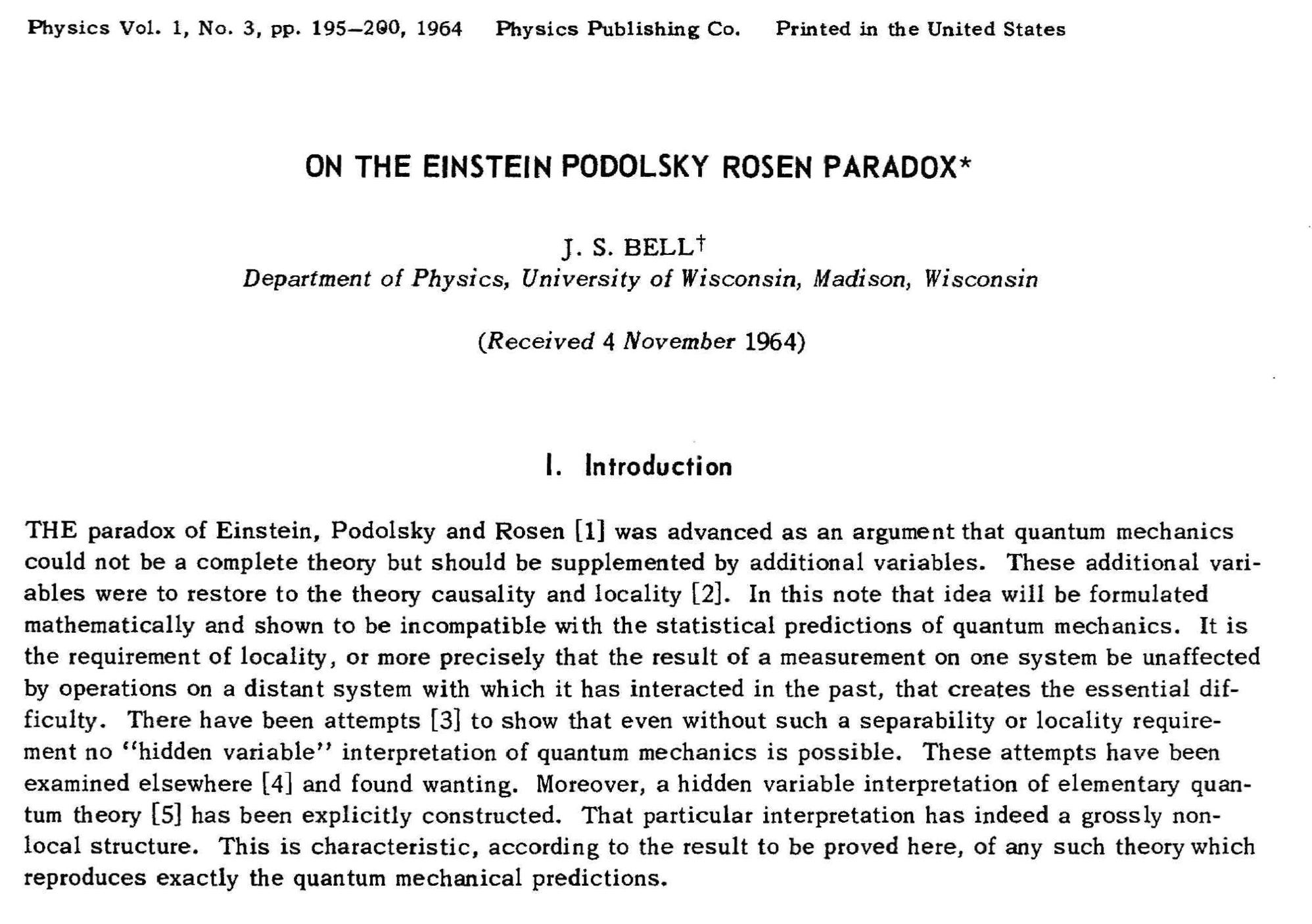
Before we address the most obvious question prompted by Jordan’s poem, what exactly Bell’s theorem is, we must look into a paper that preceded it. Bell’s 1964 paper, “On the Einstein-Podolsky-Rosen Paradox,” was written in response to an earlier paper by Albert Einstein, Boris Podolsky, and Nathan Rosen (otherwise known as “EPR”), which sought to demonstrate that quantum mechanics was an incomplete theory using two entangled particles, where the state of one determines the state of the other.
(A brief side note on entanglement: entangled states can occur from a variety of causes, including close interaction, a shared origin, or needing to fulfill conservation of momentum or energy; for example, an unstable atom undergoing beta decay will produce one electron and one neutrino. In this case, even though the decay is random, the available energy is shared between the electron and neutrino in a way that preserves conservation of energy and results in the entanglement of the two produced particles.)
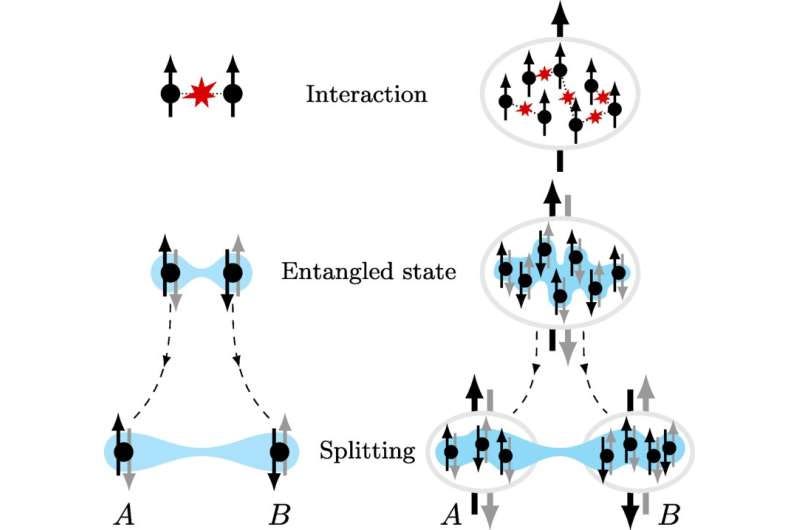
Suppose then, as the thought-experiment did, that the entangled particles are accelerated to opposite sides of the universe. According to quantum mechanics, if a scientist somehow measures the quality of one particle, the state of the other particle will immediately be known. For example, if the initial spin state of the entangled system is 0, and the scientist measures the spin of particle A to be +1, then, following conservation laws, we know that the spin of particle B must be -1.
However, while the entangled particles abide well enough by theories of conservation, they seemingly violate another theory: namely, Einstein’s theory of relativity, which states that c, the speed of light, is the universal speed limit, which nothing can surpass. But according to quantum mechanics, which states that the particles did not have a single, definitive spin until measured (like how Schrödinger’s cat is neither dead nor alive before the box is opened), measuring one particle appears to determine the state of the pair instantaneously. In order for particle B to instantly take on the counter-quality of particle A, says EPR, particle B must receive some sort of signal from particle A, which is impossible because that would mean that this signal can travel faster than light.
In order to solve what Einstein called “spooky action at a distance [spukhafte Fernwirkung],” EPR concluded that the particles must have “hidden variables.” In this case, the hidden variables, or fundamental information embedded in each particle that would lead to a pre-determined outcome, mean that particle A always “knew” that it would end up with a spin of +1, and particle B likewise “knew” that it would have a spin of -1. In this picture, relativity is preserved because no information needs to travel between the particles after measurement—however, Einstein’s proposal challenged the probabilistic interpretation of quantum mechanics, including the role played by Heisenberg’s uncertainty principle.
So, is Einstein correct that “God does not play dice with the universe?”
In 1964, Bell published the “On the Einstein-Podolsky-Rosen Paradox,” addressing the puzzle of “spooky action at a distance” with probability. Remarkably, Bell’s solution demonstrated that any local hidden-variable theory must satisfy a mathematical constraint—Bell’s inequality—that quantum mechanics can violate. While we will not delve too deeply into the mathematical proof, we will attempt to understand the theoretical workings of Bell’s inequality.
First, Bell begins with the assumption that EPR is correct. When our scientist decides to measure particle A, they choose between two possible measurement settings (for example, two different directions along which to measure spin) from which they can measure a binary quality that was pre-possessed (a0, a1) and will either turn out to -1 or +1. A second scientist may do the same for particle B. A classical combination of the two probabilities looks like this:

If the binary quality is indeed prepossessed, then there will only be a certain number of times that the particles come out with directly opposite values (+1 and -1, respectively), strongly affecting the right-hand side of the equation as a0+a1 and a0-a1 can only ever turn out to +2 or -2. The upper bound of correlation is restricted to this value.
However, using a quantum mechanical combination, the correlation of the two particles becomes far higher than the classical combination could logically yield. In the quantum mechanical treatment, however, the predicted correlations exceed Bell’s classical bound. Later formulations using qubits and Pauli matrices make this especially clear, yielding Tsirelson’s bound of 2√(2). The higher correlation between the two particles aligns more closely with what we can observe in a lab: the instant “communication” between entangled particles that allows them to take on directly opposing forms. Quantum probability works.
(If you’re interested in the full proof, I highly recommend reading Bell’s original paper. It is remarkably short and concise.)
Let us remember, now, what brought us here: June Jordan’s “Poem Number Two on Bell’s Theorem, or The New Physicality of Long Distance Love,” which illustrates the remarkable connection between physics and poetry: In developing a language for scientific reality, we enrich the language we have access to for human expression. In asking the question, “What is Bell’s theorem?” we might also ask, “What is love?” In the distant and theoretically dense, we come ever so much closer to understanding ourselves.
Now understanding Bell’s theorem, feel free to reread Jordan’s poem. What does it say to you now? Perhaps between physics and poetry, a new Theory of Everything will emerge.
Until next time.
Poetry & Physics is a deadly combination🖤🔥
those three jordan lines hit different after the bell walk. "there is no chance / there are no parts." love as entanglement without the powerpoint. i went back and read the poem twice.